
Legitimized Stigma
When cruelty becomes policy, society starts mistaking harm for order.
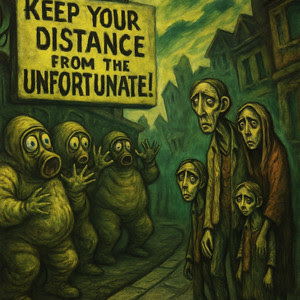
FROM DOWN HERE.↘
Ottawa loves to imagine itself as progressive.
Inclusive.
Compassionate.
A city of polite politics, bike lanes, government campaigns, carefully worded press releases, and socially acceptable concern.
But underneath that polished image sits one of the most quietly hostile systems of legitimized stigma imaginable.
Not the loud kind.
Not screaming-in-your-face discrimination.
Ottawa specializes in something much cleaner.
More bureaucratic.
More socially acceptable.
Discrimination dressed professionally enough that people stop recognizing it as discrimination at all.
Ottawa does not eliminate vulnerable people. It eliminates comfort, dignity, visibility, and access until vulnerable people disappear on their own.
That is legitimized stigma.
The kind that comes wrapped in policy language.
Signed in triplicate.
Rubber-stamped as “public safety.”
Approved through committee meetings and media briefings while everyone pretends cruelty somehow becomes ethical if enough administrative language is placed around it.
It is stigma with a communications department.
Stigma with strategic messaging.
Stigma funded by taxpayers and explained through carefully rehearsed concern.
The city constantly frames vulnerable people as disruptions to manage instead of human beings trying to survive conditions the city itself helped create.
Walk through downtown Ottawa long enough and the evidence becomes impossible to miss.
Benches designed so nobody can lie down.
Metal bars dividing public seating into tiny hostile compartments.
Spikes under bridges.
Locked washrooms.
“No loitering” signs pasted onto every available surface as if existing visibly while poor has somehow become a civic offense.
They call this urban design.
Defensive architecture.
Environmental planning.
But stripped of the euphemisms, it is very simple: the city is investing heavily in making survival physically uncomfortable for people with nowhere else to go.
Ottawa would rather spend money preventing poor people from resting than spend money preventing poverty itself.
And then there is the shelter system.
Permanently overloaded.
Chronically underfunded.
Constantly operating in emergency mode while public officials continue speaking about homelessness like it is some mysterious unsolvable phenomenon.
Meanwhile subsidized housing waitlists stretch beyond a decade.
Ten years.
An entire childhood.
A person can deteriorate mentally, physically, emotionally, and socially before ever reaching the front of that line.
Yet public discourse still frames homelessness primarily as personal failure instead of policy failure.
When somebody spends years trapped on waitlists while rents explode around them, society is communicating exactly how disposable their safety has become.
Addiction & Optics Politics
Addiction might be where legitimized stigma becomes most obvious.
Ottawa, like much of Ontario, has embraced a bizarre contradiction: publicly acknowledge an overdose crisis while simultaneously dismantling the services preventing deaths inside that crisis.
Consumption and treatment sites become political targets.
Harm reduction gets framed as surrender.
Public health responses get treated like moral failures.
And people who use drugs continue being spoken about like they are threats to society instead of people surviving unbearable realities through unstable coping mechanisms.
Every discussion gets reduced into optics.
“Protecting neighbourhoods.”
“Protecting children.”
“Restoring order.”
Rarely protecting the people actively dying.
Ottawa keeps treating visible suffering like the crisis instead of asking what produced the suffering in the first place.
And the stigma spreads outward from there.
Into healthcare.
Into housing.
Into employment.
Into policing.
Into everyday public interactions.
Poor people become viewed as dangerous.
Addicted people become viewed as morally defective.
Homeless people become viewed as contamination threatening property values and public comfort.
The public starts absorbing these assumptions so deeply that cruelty begins feeling normal.
Once society accepts that certain groups deserve less dignity, every harmful policy afterward becomes easier to justify.
Poverty As Moral Failure Then comes poverty itself.
Ottawa talks endlessly about “affordable housing” while average people get priced out of survival in real time.
Rents climb.
Wages stagnate.
Support systems collapse under pressure.
Landlords exploit loopholes.
Entire neighbourhoods become financial exclusion zones.
Yet people unable to keep up economically are still treated like they personally failed some invisible moral exam.
moral exam.
Society keeps individualizing structural collapse.
That is what makes legitimized stigma so dangerous.
It convinces people systemic violence is actually personal irresponsibility.
It is always easier politically to blame struggling people than to admit the systems themselves are producing instability.
But the damage does not stop with the people directly targeted.
It changes the emotional culture of the entire city.
It normalizes apathy.
It teaches people to emotionally disconnect from suffering happening directly beside them.
It creates a society where empathy becomes conditional and human rights start depending on public approval ratings.
And eventually everybody becomes less safe inside a culture built around managed cruelty.
The real danger of legitimized stigma is that people stop recognizing cruelty once it becomes official enough.
So the next time you see anti-homeless architecture, a shuttered consumption site, another luxury condo replacing community space, or another policy justified through vague “public concern,” ask yourself something: Who actually benefits from this?
Because it is certainly not the people these systems claim to protect.
Legitimized stigma is still stigma.
It is still discrimination.
Still prejudice.
Still social exclusion.
Just sanitized enough that people stop protesting it.
Reality: when cruelty becomes policy, society starts mistaking harm for order and exclusion for progress.
Ottawa should be better than this.