
Ottawa Condo Tenants Want To End Homelessness... Just Not in the Same Way the Rest of Us Do...
Ottawa does not need fewer homeless people visible. It needs fewer people made homeless.
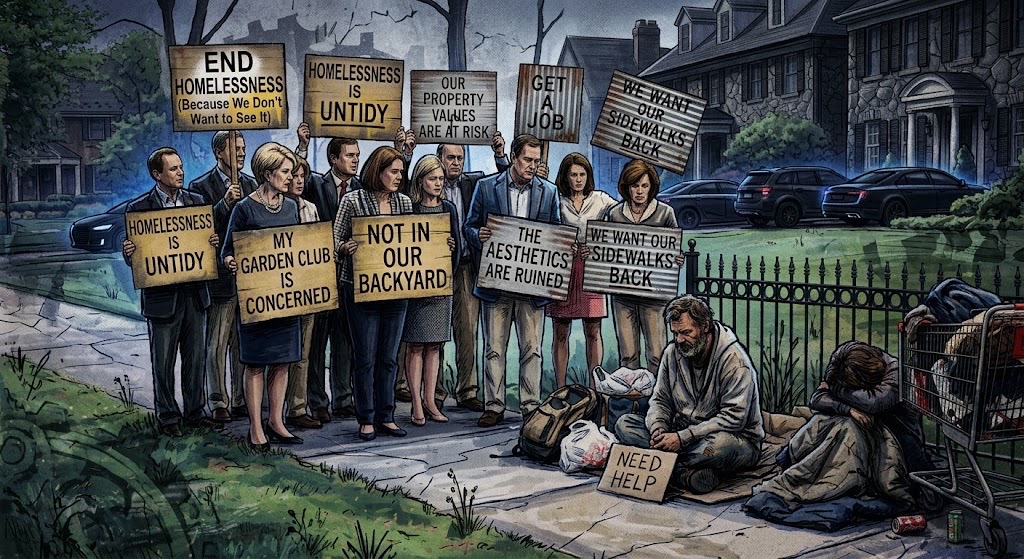
FROM DOWN HERE.↘
Every few months in Ottawa, especially in wards like Somerset and Rideau-Vanier, the same performance begins again.
Residents pack council meetings and public consultations clutching prepared statements about how “unsafe” they feel because poor people exist visibly near them.
Condo owners stand at podiums describing the horror of seeing somebody use drugs in public.
Homeowners talk about “losing access” to parks temporarily occupied by people who literally have nowhere else left to exist.
Citizens describe having to walk around tents as though they survived some kind of war zone experience instead of briefly witnessing the collapse of the society they themselves still benefit from.
Every single time, the conversation somehow becomes about the suffering of the housed.
Not the people freezing outside.
Not the people overdosing.
Not the people being repeatedly displaced.
Not the people surviving trench foot, infection, psychosis, withdrawal, violence, exploitation, sexual assault, sleep deprivation, and public humiliation.
No.
The true “vulnerable population,” according to half these delegations, is apparently condo owners who had to look at poverty on their morning coffee walk.
Ottawa has developed an astonishing ability to reinterpret discomfort as victimization whenever homeless people are involved.
You hear the same language constantly.
“My children shouldn’t have to see this.”
“I don’t feel safe.”
“The sidewalks are unusable.”
“There’s garbage everywhere.”
“We’re constantly endangered.”
“Our public spaces are being taken over.”
Meanwhile the people being discussed are treated less like human beings and more like an infestation problem the city has failed to exterminate quickly enough.
Discomfort Becomes Danger What is so infuriating is how flimsy so many of these fear narratives actually are once you strip away the panic and stigma.
A resident tells council they were “trapped” near an encampment because someone under the influence was standing near a pathway and did not immediately move when asked.
Then the actual story comes out: the person likely barely even registered what was happening, another encampment resident noticed the situation, and they moved aside so the woman could pass safely anyway.
But by the time it reaches council chambers, the story has transformed into: “I feared for my life.”
People will describe walking past somebody visibly intoxicated as though they narrowly escaped an armed ambush.
Someone muttering to themselves during psychosis becomes evidence of urban collapse.
Someone existing in visible poverty becomes framed as an act of aggression against the housed population.
Housed discomfort keeps getting treated as emergency. Homeless danger keeps getting treated as inconvenience.
The Comparison Is Grotesque The daily reality of homelessness in Ottawa is so much more dangerous than what these delegations describe that the comparison becomes grotesque.
The housed resident had to walk around a tent once.
The homeless resident is trying not to die in that tent.
The condo owner saw drug use from across the street and felt disturbed for fifteen seconds.
The person using drugs is trying to survive a poisoned supply, untreated trauma, chronic pain, severe mental illness, and a system that increasingly responds to visible suffering with displacement instead of care.
The homeowner says public disorder is degrading neighbourhood morale.
The homeless person is being forced to publicly deteriorate because every private place they once existed in collapsed underneath them already.
Somehow these conversations always center the emotional experience of the people with homes.
Somebody’s Children Too What makes it even uglier is how frequently these delegations erase the humanity of the people they are talking about.
Encampment residents become “addicts,” “criminals,” “threats,” “chaos,” “biohazards,” “safety concerns,” “vagrancy,” and “disorder.”
Rarely are they spoken about as sons, daughters, parents, survivors, disabled people, traumatized people, Indigenous people, mentally ill people, or human beings who have been systematically abandoned.
So many residents cry publicly about their children having to witness homelessness while refusing to confront the obvious truth: The people in those encampments are somebody’s children too.
Somebody once held them as babies.
Somebody once worried about them when they were sick.
Somebody once imagined a future for them.
Many of them were abused long before they were addicted.
Many were failed by schools, hospitals, foster care systems, landlords, prisons, treatment systems, social assistance systems, or violent homes before they ever ended up under a tarp beside your bike path.
But middle-class Ottawa often only encounters these people at the final stage of collapse, then mistakes collapse itself for moral failure.
Remove Them Where?
The most revealing part of all this is what almost never gets proposed.
These residents demand faster encampment removals.
Faster bylaw response.
Faster police response.
Faster cleanup.
Faster displacement.
Faster restoration of public comfort.
But almost never: more supportive housing.
more supportive housing.
more low-barrier treatment.
more mental health care.
more deeply affordable housing.
more overdose prevention.
more long-term stabilization supports.
more trauma-informed care.
more income support.
more housing workers.
more actual places for human beings to exist.
The demand is almost always: remove them faster.
Remove them where?
Nobody ever says.
Because deep down, many people do not actually want homelessness solved.
They want homelessness hidden.
They want suffering moved somewhere farther away from condo sightlines and property values.
They want the illusion of order restored without having to confront what maintaining that illusion actually requires.
Ottawa wants visible poverty managed more than it wants poor people housed.
And what that increasingly requires is the constant displacement of visibly poor people through every remaining public space they can still occupy.
Ottawa has become a city where a person sleeping in a tent is treated as an urgent emergency while luxury towers continue rising beside overflowing shelters and impossible rent prices.
A city where residents will stand before council and describe themselves as endangered because they had to witness human collapse too directly.
The truth is this: the existence of encampments is not the moral failure.
The moral failure is a city wealthy enough to build endless condos while simultaneously treating human beings sleeping outside as unacceptable visual clutter.
Reality: clearing encampments without housing people is not compassion, safety, or problemsolving. It is displacement with better public relations.
Ottawa does not need fewer homeless people visible. It needs fewer people made homeless.