
You’re Not Crazy
If the housing system feels impossible to understand, you’re not imagining it.
FROM DOWN HERE.↘
If you are homeless in Ottawa right now and waiting for housing, you have probably heard the same phrases over and over again.
“You’re on the list.”
“Your worker submitted the referral.”
“You’re prioritized.”
“Housing takes time.”
“You’re in Coordinated Access.”
Most people living through the system are expected to accept these phrases without ever being told what they actually mean.
You hand over personal information, sign forms, answer invasive questions, and then disappear into a waiting process that feels invisible and impossible to understand.
Over time, people start blaming themselves.
They think they failed somewhere, missed a step, or just are not trying hard enough.
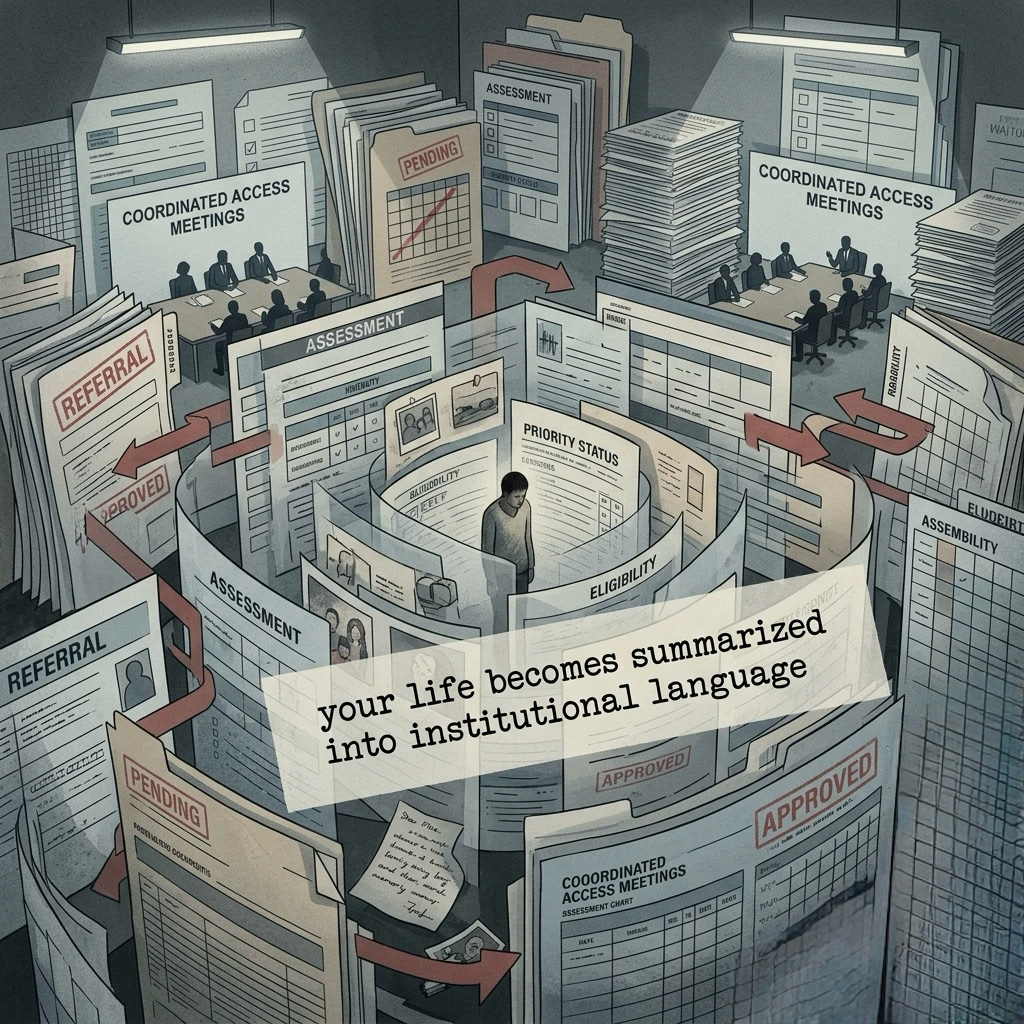
But the reality is that the system turns human beings into paperwork long before it turns them into tenants.
At the centre of the modern homelessness system is a database called HIFIS: the Homeless Individuals and Families Information System.
This is where information about homeless people gets collected, stored, updated, and shared between agencies.
When workers ask questions about your housing history, overdoses, substance use, mental health, medications, shelter stays, hospital visits, jail, income, family breakdown, violence, trauma, or where you have been sleeping, much of that information can end up in HIFIS.
Officially, the purpose is coordination.
The system says agencies need shared information so people do not have to “retell their story”
repeatedly and so services can work together more effectively.
But what this means in practice is much colder: Your life slowly becomes a file.
The By-Name List Then comes the By-Name List.
The name sounds compassionate at first. Almost personal. Like the system is finally recognizing homeless people as human beings instead of statistics.
In reality, the By-Name List is a constantly updated list of people known to the homelessness system.
Once you are entered into it, you become trackable administratively.
The system tracks whether you are active or inactive, how long you have been homeless, whether you are considered high acuity, what services you have used, whether referrals were made, whether placements failed, whether workers updated your file recently, and whether you are considered eligible for housing interventions.
The system talks about this in technical language:
Inflow.
Outflow.
Prioritization.
Matching.
But underneath the language is a much harsher reality.
The system is not managing housing abundance. It is managing scarcity.
This is the part almost nobody explains honestly.
There are nowhere near enough supportive housing units, affordable apartments, treatment beds, stabilization spaces, or long-term mental health supports to meet the actual level of need.
So the system’s real function becomes sorting people under conditions of shortage.
It has to determine who gets access first and who waits.
That means the homelessness system increasingly behaves less like a rescue system and more like a triage system.
It does not mainly solve homelessness. It organizes homelessness.
Proving Damage To sort people, the system relies heavily on assessment tools like the VI-SPDAT and SPDAT.
These questionnaires are designed to measure “vulnerability” and “acuity.”
Workers ask questions about overdoses, trauma, abuse, violence, police contact, mental health crises, substance use, memory issues, hospital visits, self-care abilities, daily functioning, and whether someone is at risk.
Then the system assigns a score.
The higher the score, the more vulnerable the person is considered to be.
On paper, this sounds objective and rational.
In reality, it creates a deeply disturbing situation where people often have to repeatedly explain the worst moments of their lives just to prove they deserve help.
Homelessness becomes something you have to narrate in institutional language.
Street-involved people already understand this instinctively.
The system often responds fastest to visible collapse.
People who are overdosing repeatedly, cycling through hospitals, obviously psychotic, heavily criminalized, or visibly deteriorating often become more legible to the system than someone quietly suffering outside.
People learn quickly that appearing “too functional” can work against them.
So you learn to describe yourself through trauma, instability, risk, and damage because those are the categories the system recognizes.
The system does not always see pain. It sees documented risk.
Meanwhile, many people assume their worker has far more power than they actually do.
Front-line workers often care deeply and work incredibly hard.
But most do not have the authority to directly house someone.
They can submit referrals, update files, advocate internally, help with paperwork, and attend case
They can submit referrals, update files, advocate internally, help with paperwork, and attend case conferences.
But they usually cannot create housing where none exists.
They cannot bypass prioritization systems, override provider decisions, or force placements to happen faster.
Many workers are trapped too.
They are trying to push people through a system with too few exits.
As someone moves deeper into the process, something more disturbing starts to happen.
The person slowly disappears and the file takes over.
At first, you are dealing with real humans face-to-face: Outreach workers, peer workers, drop-in staff, shelter workers, harm reduction staff.
These are often the people who know you best.
They know what happened to you, why previous placements failed, what environments trigger you, who exploited you, what you are afraid of, and what your file gets wrong.
But as the process moves into referrals, assessments, prioritization, and coordinated access meetings, your life becomes summarized into institutional language.
High acuity.
Complex needs.
Poor housing retention.
Substance use concerns.
Behavioural issues.
Non-compliance.
The farther away someone is from your actual life, the more authority they often have over your future.
At some point, people with actual power over placements may be discussing your future without ever having met you.
They know you through notes, incident reports, behavioural flags, assessment scores, and summaries written by others.
A whole human being becomes compressed into file language.
The system also punishes invisibility in ways many people outside homelessness never think about.
Some By-Name List systems automatically mark people inactive if there has been no contact with agencies for a certain amount of time.
Administratively this sounds reasonable.
But homelessness itself is instability.
Phones get stolen.
People relapse.
People disappear into encampments, hospitals, jail, abusive relationships, motel rooms, couch surfing, hidden sleeping spots, or total psychological collapse.
surfing, hidden sleeping spots, or total psychological collapse.
The system may interpret this as inactivity while the person is actually in the middle of the most dangerous period of their life.
The database sees absence. The street sees survival.
Housing placement failures become another layer of institutional memory that follows people.
Sometimes placements fail because the building is unsafe.
Another tenant is violent.
Isolation destroys the person psychologically.
Drug activity is everywhere.
The environment recreates institutional trauma.
But the file often reduces these experiences to phrases like “unsuccessful placement” or “difficulty maintaining housing.”
The context disappears.
Then the failed placement becomes evidence against the person in future decisions.
Once something is written into the file, it can become more real than the person themselves.
This is why so many homeless people feel like they are constantly being talked about instead of talked to.
They feel processed instead of helped.
Endlessly referred instead of meaningfully supported.
Trapped in a system where they must repeatedly prove their suffering just to remain visible.
And they are not imagining it.
Much of the system genuinely functions this way now.
The tragedy is that the people closest to the suffering often have the least authority.
Outreach workers, peer workers, and trusted front-line staff may understand a person’s situation better than anyone else in the system.
But institutional power usually sits farther away, inside committees, provider reviews, coordinated access tables, and housing matching systems built around files rather than relationships.
The farther the decision moves from direct human contact, the easier it becomes to reduce a person to risk management.
Understanding this matters because people living through the system are often blamed for the failures of the system itself.
When someone has spent years waiting, cycling through shelters, losing placements, missing calls after their phone is stolen, disappearing after trauma, or giving up after repeated disappointment, the public often sees personal failure.
But much of what homeless people experience is structural.
The system is built around managing overwhelming need with limited resources.
The people trapped inside it are expected to survive the bureaucracy while already surviving homelessness itself.
Reality: too often the housing system is designed around documentation, coordination,
Reality: too often the housing system is designed around documentation, coordination, prioritization, liability management, and scarcity control first — and humanity second.
You’re not crazy. The system is really built like this.